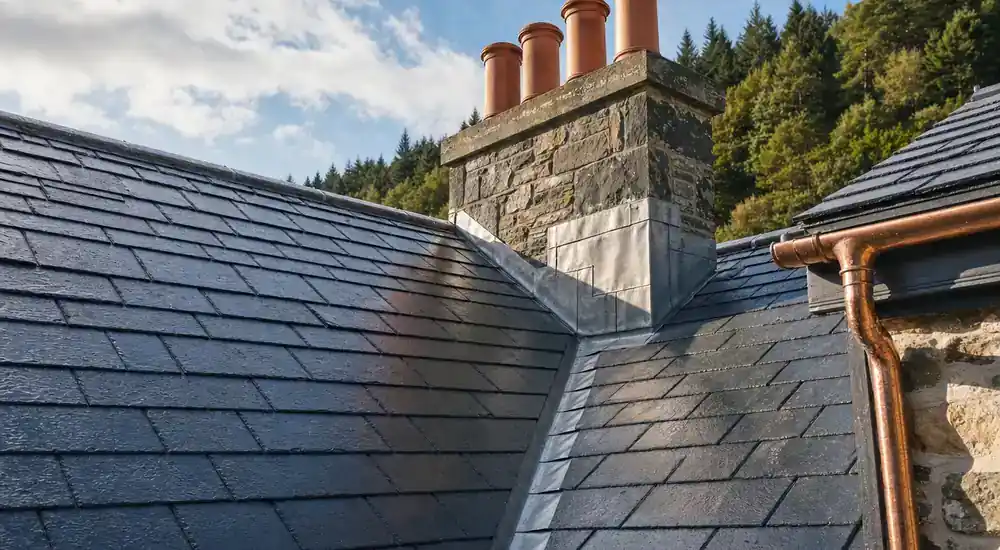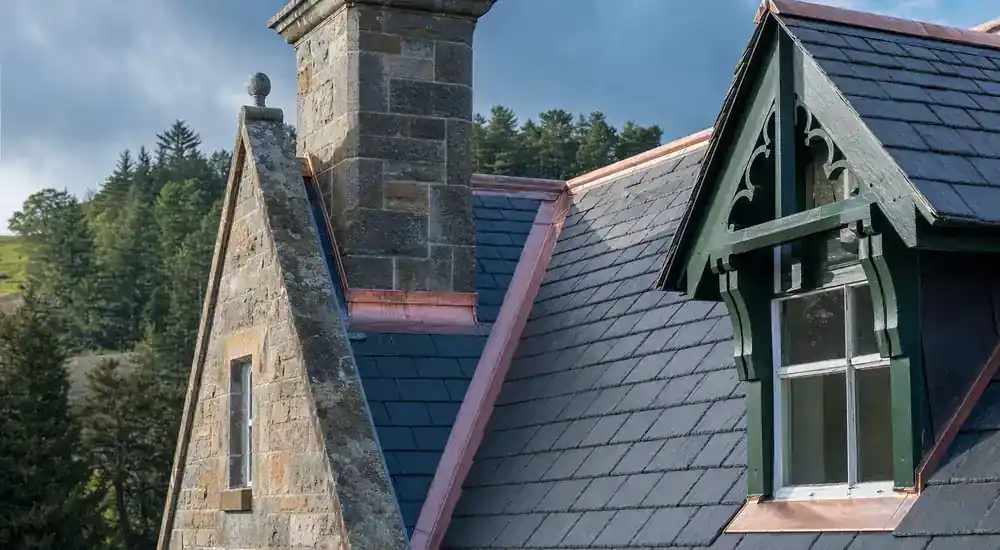
This guide focuses on the repair boundary. It shows how to distinguish a contained slate defect from distributed fixing or support problems, retain and match sound material, and handle consent-sensitive work before choosing local repair, staged intervention or wider re-slating.
Keep the decision tied to condition
- Map affected slates by slope and course instead of treating one visible gap as the whole diagnosis.
- Check slate, fixings, sarking, lead, mortar and drainage as connected fabric.
- Retain sound original slate where practicable and compare replacements by physical match, not origin alone.
- Ask the planning authority before major re-slating or any work that may affect listed character.

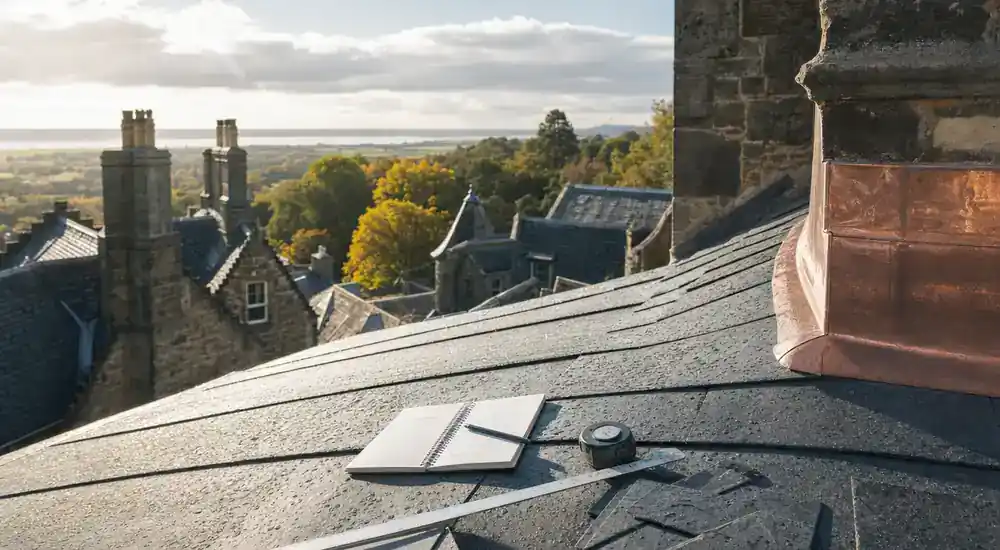
Read the pattern before choosing a repair
Begin with the number, distribution and movement of affected slates. One impact-damaged slate, repeated slippage along several courses and widespread movement across a slope point to different questions.
Contained defects
A local repair is easier to justify where the affected slate and fixing can be identified, adjacent slate appears serviceable and the sarking or support can accept a compatible fixing. Check nearby lead, mortar and drainage even when they remain outside the work boundary.
Distributed defects
Slates moving in several areas may indicate a fixing or support pattern rather than isolated breakage. Map the affected courses and slopes, then decide what close inspection or opening-up is needed; do not infer the whole roof condition from a single accessible patch.
Distinguishing slate, fixing and support condition
The Engine Shed identifies slate, nails and sarking as separate parts of the roof's performance. A repair scope should say which element has failed and which observations support that conclusion.
Slate condition
Note cracks, delamination, impact damage, missing pieces, edge erosion and whether displaced slates remain reusable. Visual colour alone does not establish soundness or source.
Fixing condition
Repeated slipped slates can be associated with corroded nails, sometimes called nail sickness, but the pattern and close observations matter. State whether the issue appears local, slope-specific or widespread and what remains unconfirmed.
Sarking and structure
Traditional Scottish slate may be fixed to timber sarking. Softness, decay, movement or concealed moisture can change the feasible fixing method, so define any opening-up before promising a local re-fix.
Retain and match material deliberately
Historic Environment Scotland guidance favours retaining sound traditional fabric and explains that replacement Scottish slate is scarce. The practical task is to recover usable slate carefully and set the physical characteristics of any replacements.
Reuse plan
State how slates will be lifted, sorted, protected and returned to the roof, and where sound originals will be prioritised. Keep a tally of breakage and rejected material rather than assuming every lifted slate can be reused.
Matching criteria
Compare size, thickness, weight, texture, colour and laying pattern. A supplier name or country of origin is not enough to establish a visual or technical match for the actual roof.
Adjacent details
Check lead junctions, ridges, skews, chimneys and rainwater goods where they affect the repair area. Replacement slate cannot compensate for an open flashing, failing masonry or blocked drainage path.
Compare local repair, staged work and re-slating
Use three explicit options so the decision does not collapse into patch versus whole-roof replacement. Each option should identify what it addresses, what it leaves and what finding could change it.
Local repair
Define slates, fixings, adjoining details, safe access and the condition assumption beneath the repair. This route is strongest when the defect boundary is observable and connected fabric remains serviceable.
Staged intervention
A staged plan can address an exposed slope or urgent junction while monitoring or surveying the rest. Give each stage a location, result and trigger for the next decision so it does not become repetitive patching.
Wider re-slating
Consider a wider scope where fixing or support problems are distributed, serviceable slate must be recovered across the slope or local work cannot create a coherent weathering detail. The proposal should still identify retained material and connected lead, mortar and timber work.
Safe access and protected-property checks
HSE guidance requires work at height to be planned by competent people using suitable access, and slate surfaces can be damaged by direct access. Listed status and conservation areas create a separate planning authority question.
Access method
State how close inspection and repair will avoid unsafe edges and unnecessary loading or breakage of slate. Ground-level observations help the early decision but are not permission for an owner to climb.
Consent enquiry
For major re-slating or a change that may affect character, send the planning authority the designation, condition notes, retained-material plan, proposed match and annotated roof area. Do not rely only on the phrase like-for-like.
A traceable result after repair
The final scope should allow another reader to see what was found, what changed and which material was retained. Future maintenance decisions can then use observed condition and repair locations rather than assumptions.
- Dated roof plan or annotated elevations showing affected slopes and courses.
- Slate, fixing, sarking, lead, mortar and drainage findings separated.
- Original slate retained, reused, rejected and replaced shown by area.
- Opening-up findings and agreed scope changes photographed.
- Access and inspection limitations stated.
- Authority correspondence and accepted details retained where relevant.
Official guidance and references
- Engine Shed: slate roofs Historic Environment Scotland guidance on Scottish slate inspection, repair, reuse, matching and permissions.
- Historic Environment Scotland: traditional building maintenance Official advice on inspection plans, connected defects, maintenance records and safe observation of traditional buildings.
- Historic Environment Scotland: traditional building repairs Official guidance on finding causes, specifying compatible repairs, retaining fabric and recording work.
- Historic Environment Scotland: listed building and conservation area consent Current Scottish guidance on changes to listed buildings, conservation areas and the planning authority's role.
- HSE: roof work Official roof-work guidance covering safe access, roof edges, weather and fragile materials.
- HSE: working at height safely Official guidance on planning, competence, equipment and the hierarchy for controlling work-at-height risk.
- HSE: fragile surfaces Official guidance on treating roof surfaces as fragile until a competent person confirms otherwise.